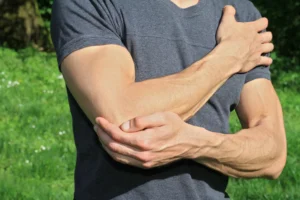

Have you ever experienced pain on the outside of your elbow when lifting a kettle, gripping a tennis racket, opening a jar, or even shaking someone’s hand?
You might be experiencing a condition commonly known as tennis elbow.
Despite its name, tennis elbow affects far more than just tennis players. It’s a common problem among people who repeatedly use their hands, wrists, and forearms, and it can make everyday activities surprisingly uncomfortable.
Fortunately, physiotherapy offers several approaches to managing this condition and helping people return to their usual activities.
What is tennis elbow?
Tennis elbow, also known as lateral elbow tendinopathy or lateral epicondylalgia, causes pain around the bony prominence on the outside of the elbow.
This is where several forearm muscles attach through a shared tendon.
These muscles are responsible for movements such as extending your wrist, straightening your fingers, and helping stabilize the wrist while gripping objects.
When the tendon is exposed to more load than it can currently tolerate, it can become painful and sensitive.
Although tennis elbow was traditionally described as an inflammatory condition, persistent cases are better understood as involving changes in tendon structure, loading tolerance, and pain sensitivity rather than inflammation alone.
How do you get tennis elbow?
Tennis elbow commonly develops when the demands placed on the forearm increase beyond what the muscles and tendon are accustomed to.
This may happen gradually or following a sudden increase in activity.
Common contributing activities include:
- Tennis and racket sports: Repeated gripping and backhand strokes
- Gardening: Pruning, digging, gripping tools, and repetitive wrist movements
- Trades and manual work: Using screwdrivers, drills, hammers, and other tools
- Weight training: Lifting weights and performing gripping exercises
- Office work: Repetitive mouse or keyboard use, particularly when combined with other forearm demands
- Household activities: Carrying heavy shopping bags, lifting pans, or other repetitive gripping tasks
Sometimes there is no obvious trigger.
What are the symptoms?
The most common symptom is pain on the outside of the elbow, which may extend into the forearm.
You might notice:
- Pain when gripping or lifting objects
- Discomfort when shaking hands
- Pain when extending your wrist against resistance
- Reduced grip strength because gripping is painful
- Tenderness over the outside of the elbow
- Symptoms that worsen after repetitive activity
Tennis elbow can persist for weeks or months and may interfere with sport, work, or daily activities.
Other conditions can also cause lateral elbow pain, so a proper assessment is useful before beginning treatment.
How does physiotherapy help tennis elbow?
1. Progressive loading and strengthening exercises
Progressive exercise is an important part of physiotherapy treatment for tennis elbow.
Although it might seem logical to completely rest a painful tendon, prolonged avoidance of activity may leave the forearm less prepared for the demands of everyday life.
Instead, physiotherapy aims to gradually rebuild the tendon and muscles’ ability to tolerate load.
Depending on your symptoms, your physiotherapist may recommend:
Isometric exercises: Holding the wrist in a fixed position against resistance. These can provide a manageable starting point when movement is uncomfortable.
Eccentric exercises: Slowly lowering the wrist against resistance, helping progressively challenge the wrist extensor muscles.
Concentric exercises: Lifting the wrist against resistance, developing forearm strength through movement.
Grip-strengthening exercises: Gradually improving tolerance for gripping and lifting tasks.
As symptoms improve, exercises can become more demanding and specific to your activities, such as tennis, gardening, or weight training.
The key is choosing an appropriate starting load and progressing gradually.
2. IMS and Dry Needling
IMS (Intramuscular Stimulation) and Dry Needling are treatments that involve inserting fine, sterile needles into selected muscles or other tissues.
In patients with tennis elbow, needling may target painful forearm muscles or, depending on the technique, tissues associated with the affected tendon.
Clinical research suggests dry needling can help reduce pain and improve function in people with lateral elbow tendinopathy (the 2022 physiotherapy clinical practice guideline includes a recommendation supporting tendon or trigger-point dry needling for this condition).
At our clinic, our IMS/ Dry Needling trained physiotherapists may consider IMS/Dry Needling as an addition to a rehabilitation program when clinically suitable.
The goal is to help manage symptoms while gradually restoring strength and activity tolerance.
3. Shockwave Therapy
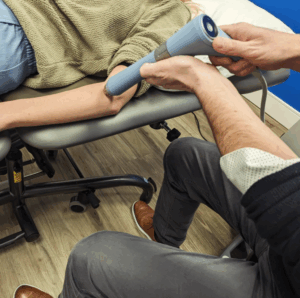
Shockwave Therapy uses acoustic pressure waves delivered through a handheld treatment device.
It is sometimes considered for persistent tendon problems, including tennis elbow, particularly when symptoms have lasted several months.
Several clinical studies and recent reviews have reported reductions in pain following Shockwave Therapy. However, shockwave Therapy should not be viewed as a standalone solution or a replacement for progressive exercise. Instead, combining this treatment, alongside an appropriate exercise plan and possibly IMS/ Dry Needling, often provides meaningful relief and improvements.
Should you stop playing tennis or exercising?
Not necessarily!
In many cases, activities can be modified rather than stopped completely.
This might involve reducing playing time, adjusting training intensity, temporarily limiting repetitive gripping, or changing exercises that aggravate symptoms.
The aim is to find a manageable level of activity while gradually rebuilding strength.
For tennis players, your physiotherapist may also discuss racket grip size, playing technique, training volume, and a progressive return to the court.
How long does tennis elbow take to improve?
Recovery varies depending on how long symptoms have been present, how irritable the tendon is, and the demands of your work or recreational activities.
Some people improve within several weeks, while persistent cases may require months of progressive rehabilitation.
The important thing is to focus on steady improvement in pain, strength, and function rather than expecting an instant fix.
Getting back to the activities you love
Tennis elbow can be frustrating, especially when something as simple as lifting a cup of tea becomes painful.
At Penticton Physiotherapy & IMS Clinic, we can assess your symptoms, help you understand what’s contributing to your pain, and develop an individualized rehabilitation plan.
Treatment may include progressive strengthening, activity modification, hands-on techniques, shockwave therapy and selected additional treatments such as IMS/Dry Needling.
Ready to book an appointment with one of our physiotherapist? Click HERE to check our availability!
Whether you’re a tennis player, gardener, tradesperson, or simply struggling with everyday gripping and lifting, physiotherapy can help you work toward getting your elbow moving comfortably again.
References
- Lucado AM, et al. (2022). Lateral Elbow Pain and Muscle Function Impairments: Clinical Practice Guidelines. Journal of Orthopaedic & Sports Physical Therapy, 52(12), CPG1–CPG111.
https://doi.org/10.2519/jospt.2022.0302